


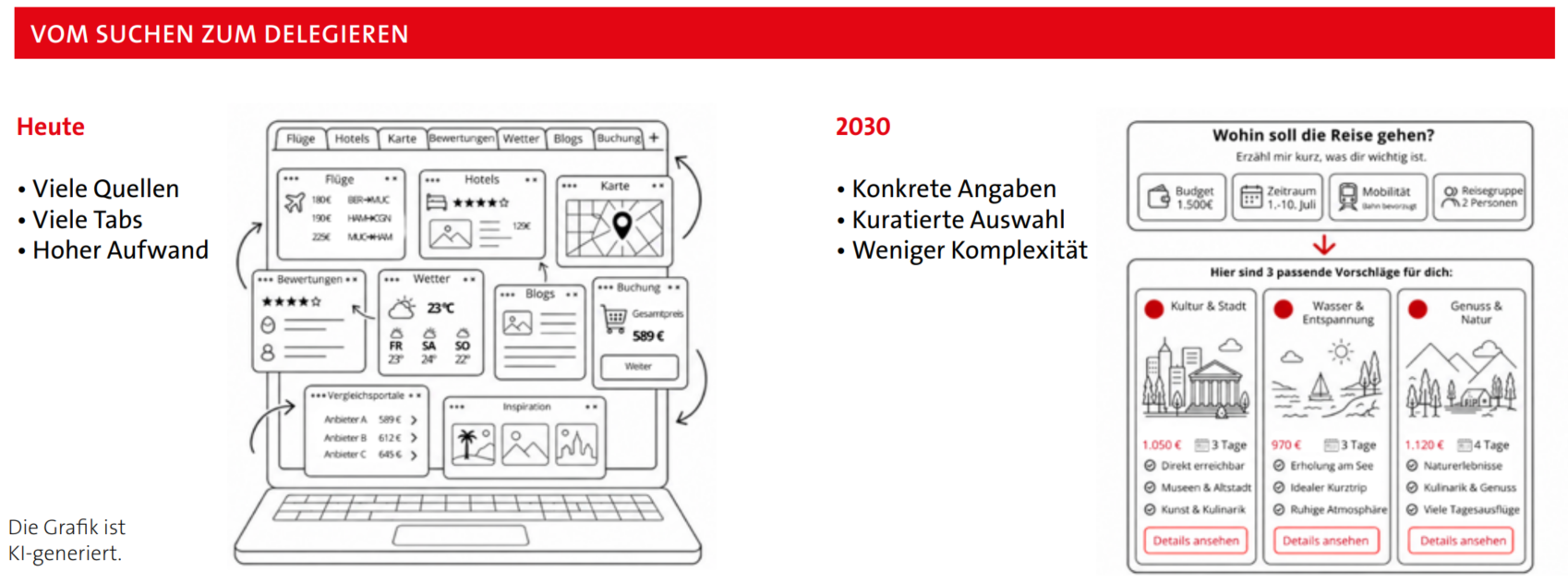
“Can you quickly put together a trip for me?” Even now, this phrase is often not a request to a travel agency, but an instruction to an AI system. Travelers specify their preferences: budget, travel dates, transportation needs, and perhaps some details about their travel group. The AI then suggests suitable options, aggregates information from multiple sources, and distills the complexity down to the essentials. The tedious task of comparing dozens of tabs is transformed into a curated selection that can be customized with just a few clicks.
For standard trips, AI not only provides inspiration but is also increasingly handling the booking process itself. Prof. Dr. Eric Horster succinctly describes this trend: By 2030, standard inquiries will largely be delegated to AI agents, while personalized advice will remain for cases where things get complex. But this will not be as a replacement for AI, rather as a complement, because with AI support, people can better assess situations, weigh options, and provide more empathetic advice.
Does that mean people will be traveling entirely “AI-natively” by 2030? Probably not. There’s a lot to be said for hybrid patterns. Travel decisions are emotional, often uncertain, and sometimes risky. Prof. Dr. Julian Reif points out that traditional sources—and especially one’s social circle—are likely to continue playing an important role. And then there’s the counter-trend: When everything is planned out, the unexpected is lost. Horster expects that this very factor will become a tipping point at which adventure and chance will regain value.
“Travel decisions made by consumers are and will continue to be shaped by a high degree of uncertainty and emotionality, which is why it seems unlikely that these decisions will be fully delegated to AI in the short term. A hybrid approach to information-seeking is more likely.”
Visibility Becomes a Data Issue
The biggest shift by 2030 will be in the logic of visibility. When answers are generated directly within conversational interfaces—such as Perplexity or Google’s AI mode—the importance of clicking through to a website diminishes. Then, what matters less is who has the most attractive website, and more is who reliably appears in the data streams. Prof. Dr. Tobias Blask sums up this consequence in a simple formula:
“Anyone who doesn’t appear in the LLMs’ data stream doesn’t exist for the guest.”
The website isn’t going away, though; it’s just that its role is changing. It’s becoming more of a bridge of trust operating in the background. Reif describes it as a reference and verification source, along the lines of: “I’d better double-check that.” Prof. Dr. Stephan Bingemer makes it clear that the data infrastructures behind websites can remain valuable, even as the traditional SEO and SEA ecosystem loses relevance.
Trust: Accuracy and Transparency
With the new recommendation system, the pressure to maintain credibility is increasing. Bingemer sums it up pragmatically: High-quality, curated results and successful bookings build trust, while failed bookings destroy it. However, performance will not be evaluated solely on technical grounds in the future. As advertising and commercial interests become more heavily integrated into AI responses, it will become more difficult for users to discern whether a recommendation stems from a match with their preferences or from an economic incentive. Reif therefore considers transparency and labeling to be essential.
“Platform dependency isn’t decreasing—it’s getting worse. AI reinforces existing power structures.”
And then it gets very specific: Who sits between the user and the content and controls what gets recommended? Horster considers the hope that AI could simply break the dominance of the leading platforms to be naive. He expects the situation to intensify, because data power, reach, and infrastructure are concentrated in the hands of just a few players. Prof. Dr. Heinz-Dieter Quack points in the same direction: AI systems and platforms are becoming new intermediaries that help determine which content appears in recommendations.
On the Ground: Subtle Densification Instead of Science Fiction
What will the on-site travel experience look like in 2030? Less science fiction, more subtle densification. Reif considers widespread use of smart glasses or similar gadgets unlikely. Instead, he envisions widespread use of low-tech formats such as translation, audio guides, and route planning—driven by the market penetration of smartphones—while language simultaneously becomes the decisive interface. Horster describes a situation in which AI-powered dialogue runs continuously in the background via headphones while travelers experience their surroundings.
“If LLM systems consistently curate the same experiences, authenticity may be lost, and other distribution channels could regain prominence—if they still exist by then.”
What Remains of the Adventure?
Precisely because AI makes travel more efficient, another question comes to the fore: What remains of the adventure? Bingemer sees a danger that technological assistance will diminish the sense of adventure in travel. While fully optimized travel experience chains increase efficiency, they also reduce the potential for surprises. Blask warns: Systems reinforce preferences rather than broadening them. Cultural friction—which he describes as the heart of good travel—can be filtered out. This leads to a concrete design challenge: Recommendations should be optimized not only for a good fit, but also for diversity and genuine discovery.
Social Issues: Who Wins, Who Loses?
The 2030 scenario is also a social issue. The opportunities are clear: AI can facilitate access, for example through language accessibility. Risks are just as tangible when popularity-driven logic is reinforced and less digitized offerings fall by the wayside. Quack sees the danger that algorithmic recommendations may unintentionally limit diversity.
“DMOs should therefore invest more in building high-quality databases, process them in a standardized manner, and make them available in a way that ensures maximum interoperability.”
What does this mean for DMOs?
For DMOs, the implication is clear: If you want to remain relevant in 2030, you don’t necessarily need another tool—you need an organization that is capable of learning. Horster emphasizes organizational capability, agility, and building expertise. Quack emphasizes that structured, up-to-date, and machine-readable data are becoming key prerequisites for digital visibility. Bingemer urges people to share data: “If you don’t share anything, you won’t be found.” At the same time, the promise of tourism remains deeply human: Technology can provide guidance and break down barriers. However, what continues to make the difference are real places, real encounters, and offerings that deliver on what digital systems promise.


Matthias Burzinski
destinetCHANGE | destinet.de
Matthias Burzinski is the founder of destinet.de and destinetCHANGE, as well as the initiator of the AI Club Tourism. He guides destinations, companies, and organizations in the tourism sector through digital transformation. In doing so, he combines change management, market research, organizational development, and artificial intelligence to create practical solutions. He develops AI architectures, implements use cases, and empowers teams through workshops, academy programs, and learning platforms.
Learn more about him at: www.destinetchange.de and www.ki-clubs.de
Image: © Matthias Burzinski

Timo Förster
destinetCHANGE | AI Consultant
Timo Förster helps tourism organizations integrate artificial intelligence effectively into their daily work. Through workshops, webinars, and the development of practical solutions, he combines AI expertise with a people-centered approach.
Image: © Timo Förster