

A Complementary Approach to the Data Infrastructure for Tourism Destinations in German Tourism
Tourism in Germany needs a reliable and comprehensive database. Destination management organizations (DMOs) have been working on this for years. However, there is still no complete inventory of tourism data to serve as the basis for digital services. Although the federal states' data hubs have already invested a great deal of effort into consolidating regional systems into a central state data infrastructure or into establishing central data management infrastructures, these datasets can only be used by digital communication channels operating nationally or internationally with certain limitations. Scalable provision often still fails due to a lack of open licensing. This is particularly true in the area of image rights. As a result, not all data can be made available through the only nationwide data inventory (the Knowledge Graph for German Tourism). When digital communication channels operating nationally or internationally attempt to retrieve all state-level inventories individually, this leads to a problem of duplicates: information is sometimes contradictory and can confuse visitors when data from different sources is retrieved and then presented side by side without being consolidated.
Based on this challenge, the DIANA-T project—funded by the Federal Ministry of Research, Technology, and Space (BMFTR)—has developed a concept for a forward-looking data architecture that could be operated in a manner complementary to the existing open data approach .. This paper aims to present the concept as well as the prototypical development to date be presented. The goal is to discuss this on a broader basis and thus take it out of the narrow context of the project.
Two complementary pillars
The DIANA-T project’s approach combines two complementary approaches:
1. Open Data & Knowledge Graph
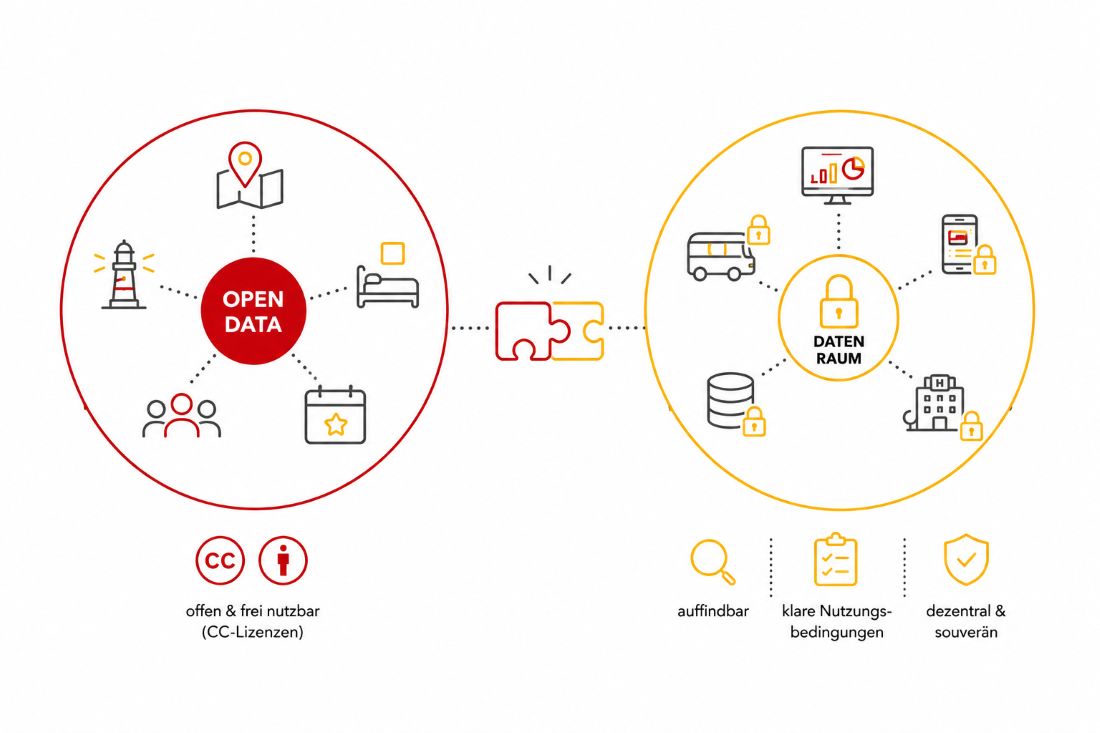
Publicly accessible and legally unrestricted data is shared using established structures and data models. One example of this is the Germany Tourism Knowledge Graph. Creative Commons (CC) licenses provide the legal framework for this broad use.
2. Sovereign Data Rooms
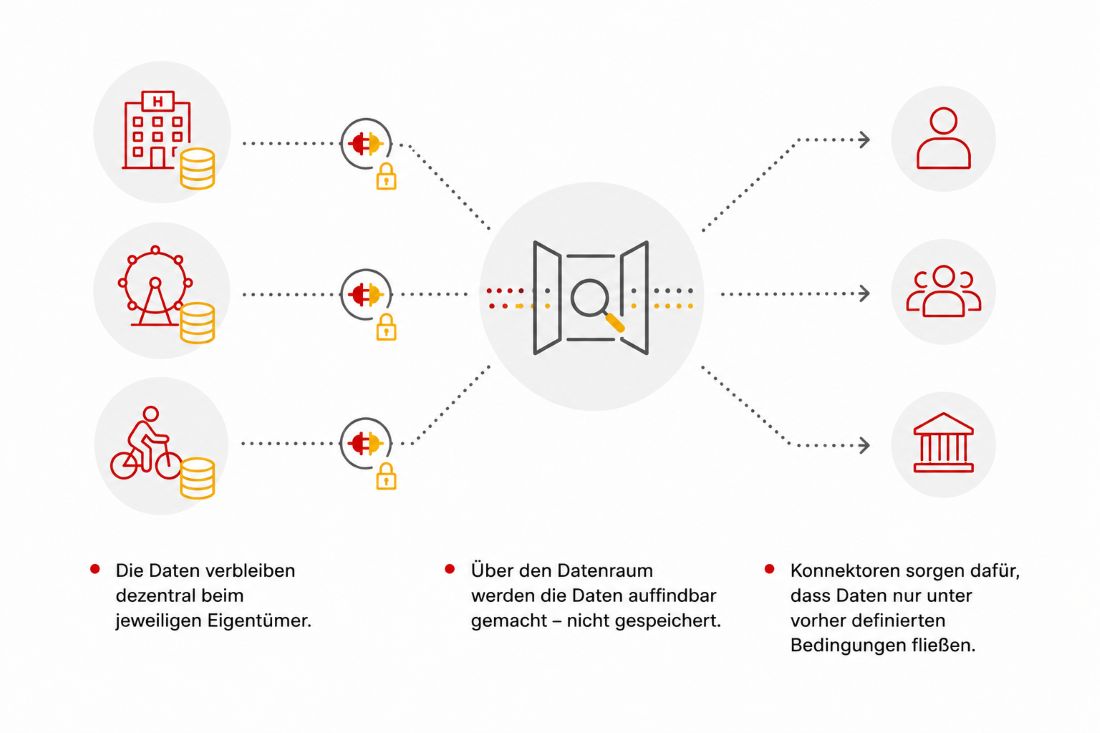
A tourism data room can serve as a technological complement. This allows for the exchange of data subject to licensing restrictions. What makes this unique is that data sovereignty is fully preserved for the destinations providing the data. This is made possible by the fact that a data room catalogs the data but does not store it. Thus, while the data is discoverable, its use is only permitted through an automated authorization process. The data therefore remains decentralized with its respective owner. The data room enables data to be shared via special connectors and only under clearly defined terms of use.
From a thought experiment to real-world application
The prototype (working title in the DIANA-T project: “Data Hub”) was developed through several iterative cycles. It began with a so-called “pretotype.” During the first phase of the project, this served to clarify fundamental questions: How can master data be used across regions without duplicate maintenance? How can identical data be uniquely mapped? The pretotype helped to visually clarify the theoretical data flows and roles between DMOs, hotels, attractions, and guests.
Working closely together, the project partners developed an interactive prototype from the initial concept. This prototype allows users to experience the benefits of the data room firsthand through a real software application. It is now actually possible to connect multiple non-open data sources to a test data room, consolidate them there in a structured manner, and manage them digitally.
Standardization at the state level
A major advantage of this approach is the ability to leverage existing structures. Many state-level tourism data hubs already use the data models of the Open Data Tourism Alliance (ODTA) and have licensed their data under Creative Commons. This existing framework provides a solid foundation for:
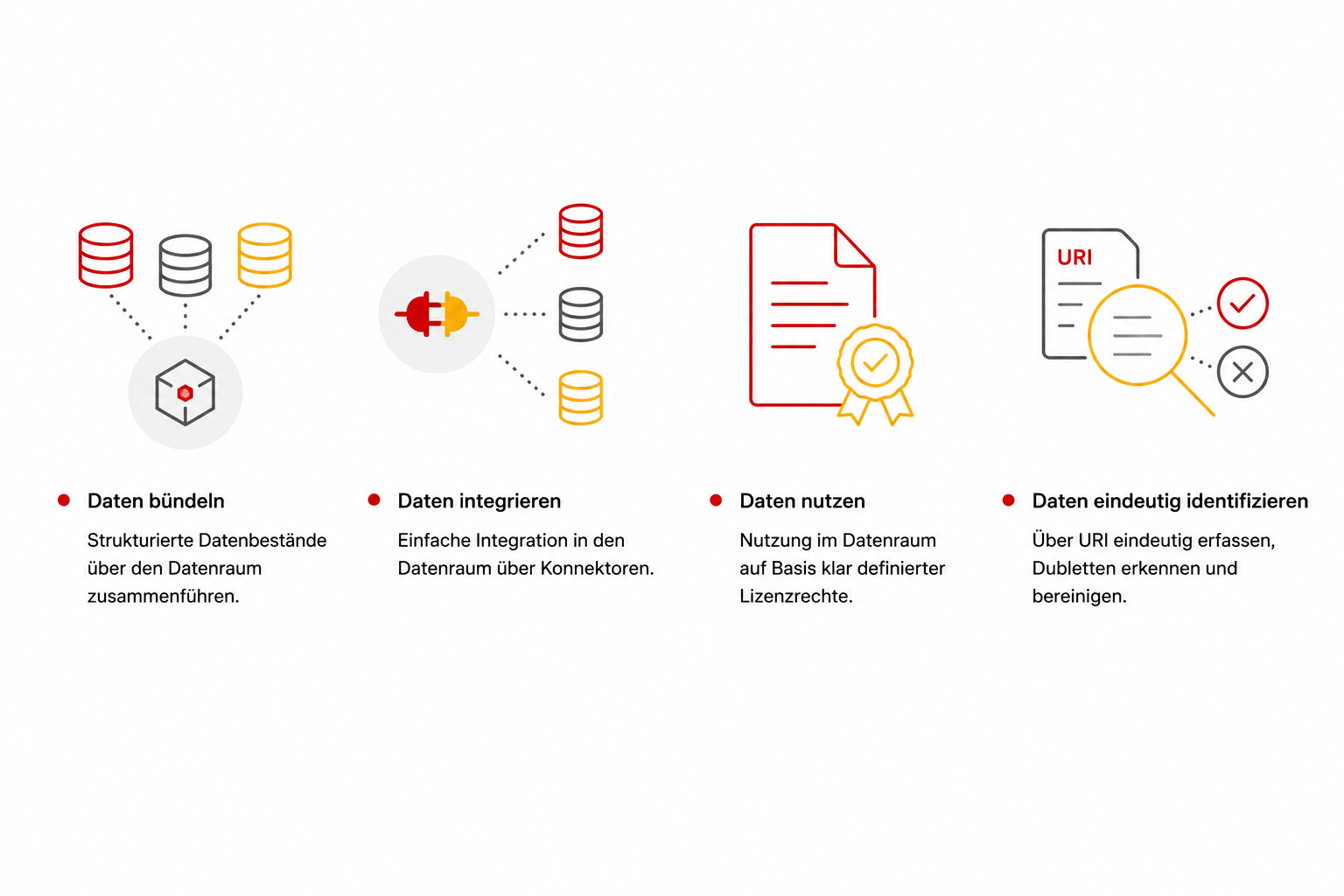
- The consolidation of structured data sets via the data room.
- The simplified integration of these datasets into a tourism data room using connectors.
- The use of the data sets within the data room based on clearly defined license rights.
- The datasets can be uniquely identified using a URI-based approach (based on OpenStreetMap (OSM)), which allows duplicate records to be detected. In a subsequent step, these could be cleaned up; however, this has not yet been implemented within the scope of the prototype.
The Real-World Test Site: The Lower Saxony-Brandenburg Border Region
The theoretical concept was tested under real-world conditions. To this end, the DIANA-T Consortium defined a specific use case designed to test access to cross-regional POI data. The border region between Lower Saxony and Brandenburg serves as the ideal practical application scenario. Why this region in particular? Because the typical problems of day-to-day tourism DMO operations are magnified here: At state borders, it is often necessary to laboriously maintain identical objects in two different state systems.
The research project is now specifically testing the cross-border identification of selected data records and their transfer between two state databases in the Lenzen (Elbe) region:
- The Elbe Cycle Route
- The Lenzen Visitor Center
- The Lenzen Border Tower
These real-world datasets from Brandenburg and Lower Saxony are clearly displayed in the prototype alongside data from OpenStreetMap (OSM) in the shared data space, but they remain in their original sources.
“The Data Hub prototype establishes a framework for a reliable data inventory that standardizes different data sets and transparently lists rights for further use.”
Jan Hoffmann, TMB Tourismus-Marketing Brandenburg GmbH
Unique Identification Using URIs
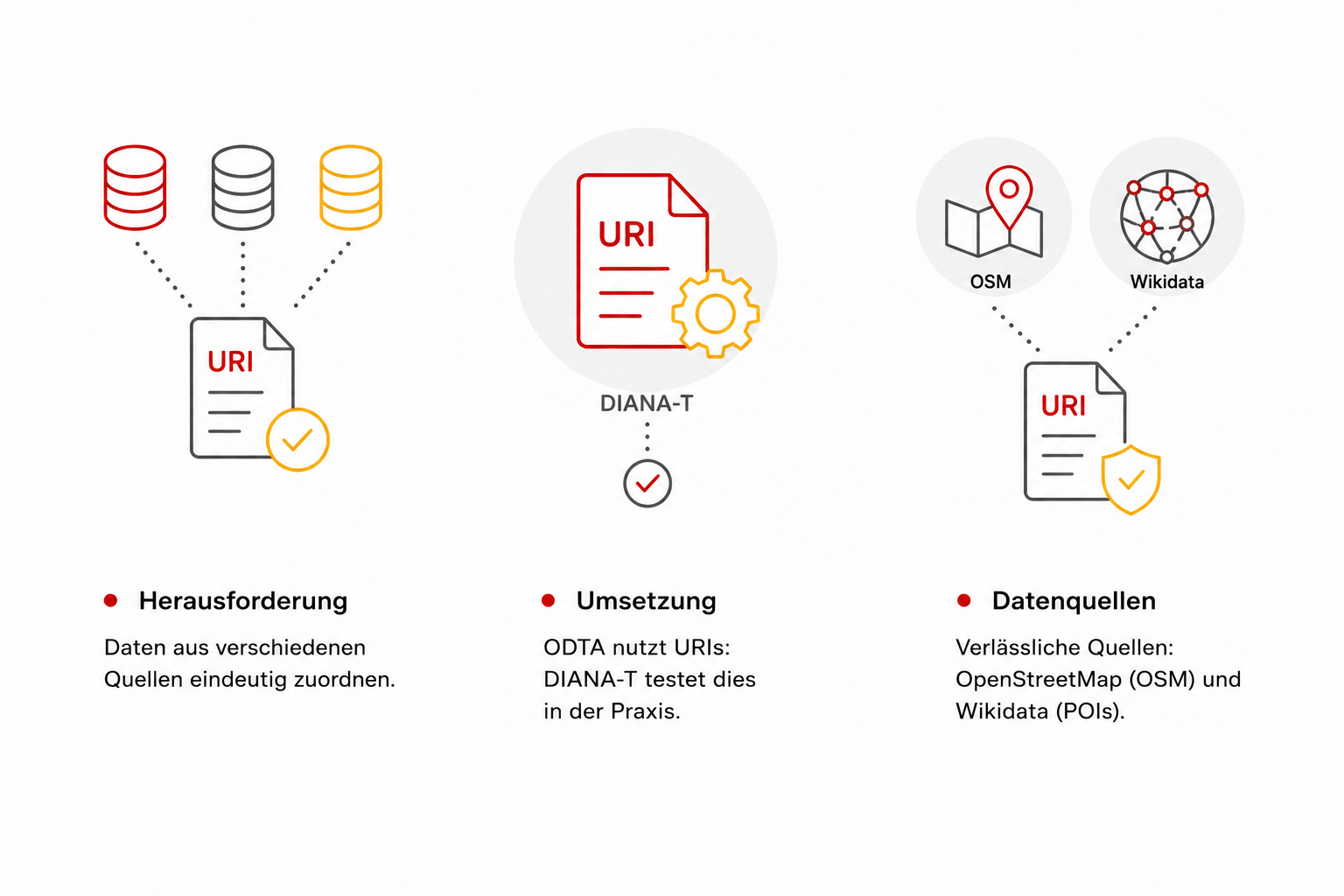
- The challenge: Data must be uniquely mappable across various state databases and, consequently, across different systems.
- Implementation in the project: The ODTA relies on so-called Uniform Resource Identifiers (URI) for this purpose. As part of DIANA-T, this concept is now being tested in practice.
- Data Sources: The identifiers for the data records come from reliable sources. OpenStreetMap (OSM) and Wikidata are currently being tested in the research project for the points of interest (POIs) mentioned.
A Look Inside the Software: How Rights Management Works Technically
What exactly does the process look like behind the scenes of the prototype? The technical implementation is based on the so-called Eclipse Dataspace Components (EDC) in collaboration with Fraunhofer FIT. When a tourism organization wants to make data available in the data space, it enters it via a secure interface (connector endpoint) as a standalone “asset.”
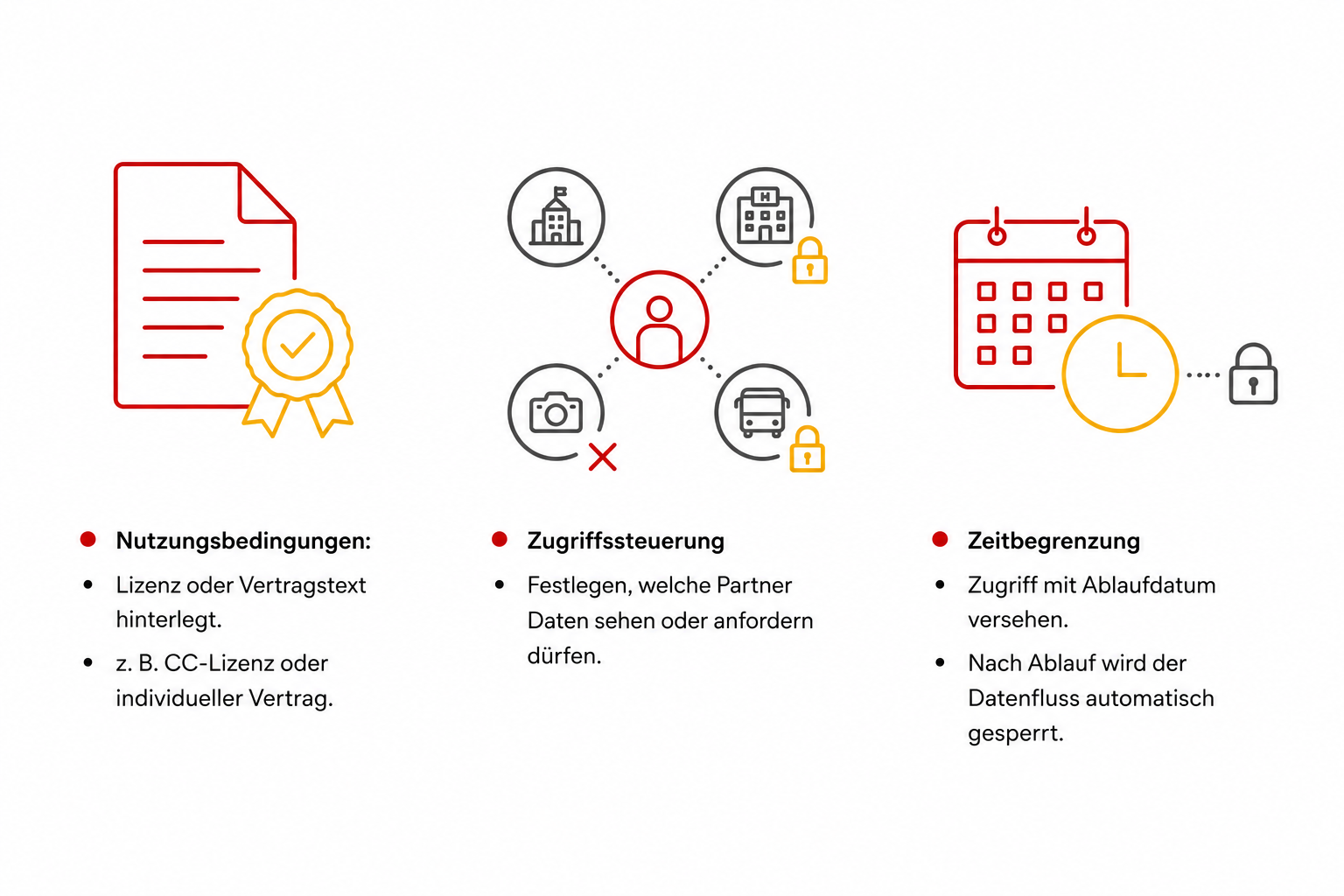
The key advantage for data protection and licensing is the ability to precisely define digital guidelines (known as “policies”). In the prototype’s user interface, data providers can flexibly define conditions and link them together:
- Terms of Use: The exact text of the license is provided here. It does not matter whether this is one of the CC licenses, an individual photographer’s contract, or other contract-specific terms.
- Consumer’s Participant ID: The destination can restrict which specific partners in the data network are allowed to view or request the data.
- Time Limit: Access can be set to expire on a specific date, after which the connector automatically blocks the data flow.
To ensure that service providers or other DMOs can find this shared data in the first place, the Data Hub uses standardized metadata. Each data package is automatically tagged with a unique connector ID, the name of the data provider, the contractual terms of use (Contract), and the exact data type (e.g., POI, event, or tour). The actual exchange of data then takes place fully automatically and securely in a four-step process, from asset selection to the final conclusion of the contract at the log level
Conclusion: A Scalable Infrastructure for the Future
The “Data Hub” conceptual prototype standardizes different data sets. It transparently maps out all terms of use. This creates a scalable infrastructure. In addition to the existing Open Data Initiative, this could enable other data sets—which have been restricted until now—to be made securely available in the future through a tourism data hub.

Eric Horster
West Coast University of Applied Sciences
Eric Horster ist Professor an der Fachhochschule Westküste im Bachelor- und Masterstudiengang International Tourism Management (ITM) mit den Schwerpunktfächern Digitalisierung im Tourismus und Hospitality Management. Er ist Mitglied des Deutschen Instituts für Tourismusforschung.
Mehr zur Person unter: http://eric-horster.de/